News

Leaders and partners from across the health care system came together in September for the Medical Council of Canada (MCC)’s 2026 Annual Meeting. Under the theme Right skills, right scope, right time: Strengthening Canada’s physician workforce, participants considered some of the complex challenges facing the health care system and explored opportunities for strengthening the country’s physician workforce to better support access to safe, high-quality care.
The meeting, held at the MCC’s headquarters in Ottawa on September 28 and 29, drew participants from partner organizations who heard from a variety of speakers and presenters, including a keynote address from Dr. Samantha Nutt, a physician and the founder of War Child Canada. Drawing on her humanitarian work, Dr. Nutt spoke about the challenges inherent in creating change inside complex systems and encouraged participants to question assumptions, confront difficult problems, and recognize that progress may require imperfect solutions. The audience also heard from Nik Nanos, chief data scientist and founder of Nanos Research, who opened the meeting by sharing findings from a recent national public opinion research commissioned by the MCC.
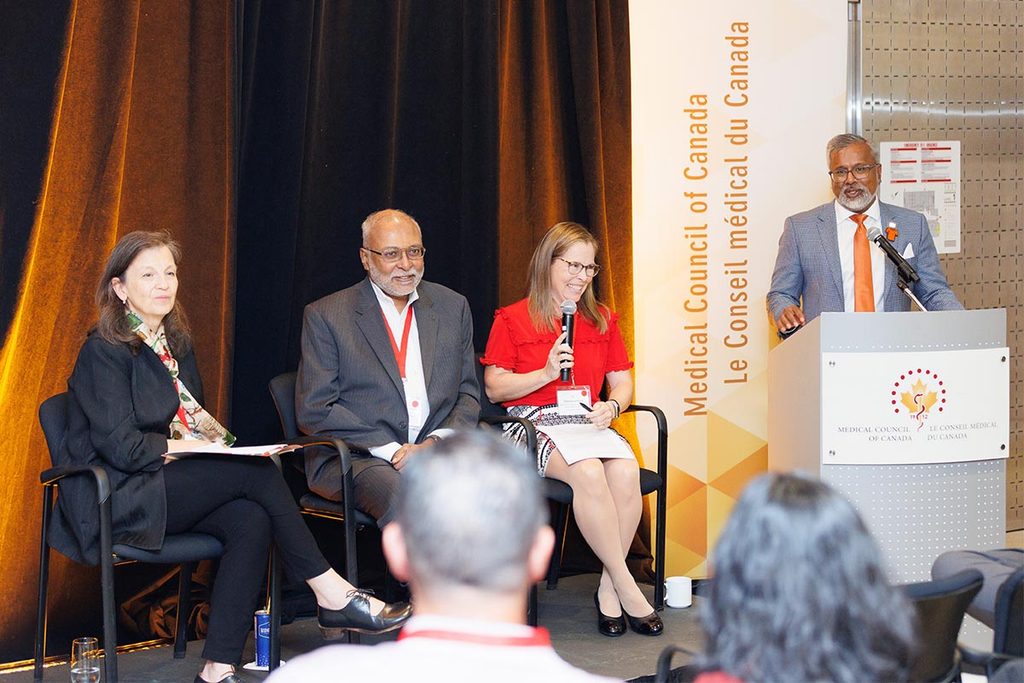
A panel discussion that focused the conversation on physician mobility and jurisdictional pathways brought together speakers from both Canada and the United States. In a conversation moderated by MCC CEO Dr. Viren Naik, panelists Ms. Stephanie Price, executive director of the Federation of Medical Regulatory Authorities of Canada, Dr. George Abraham, chair of the Board of Directors of the Federation of State Medical Boards, and Dr. Lyuba Konopasek, senior vice president of Intealth, discussed how regulators and other organizations can respond to physician workforce needs while maintaining public trust, highlighting the contributions of internationally trained physicians.
This session examined the experiences of Canadians studying medicine abroad and the barriers they encounter when seeking to return to Canada for postgraduate training. After hearing first-hand perspectives from medical students studying at the Ross University School of Medicine in Barbados, where Dr. Holmes is Dean, the group identified recurring challenges for these students, including fragmented information, financial barriers, and limited access to electives and residency positions. Led by Dr. Holmes and Dr. Harvey, a physician and program director with the Ottawa Hospital, the ensuing group discussions centered on the need for greater transparency and predictability for Canadians choosing to study abroad, as well as practical opportunities to better support them, from providing information earlier in a student’s journey and creating more centralized resources, to strengthening connections and mentorship between students abroad and the Canadian medical system, including how training capacity could better respond to Canada’s physician workforce needs. Participants emphasized the importance of considering fairness and access across different groups of internationally trained physicians, with the broader goal of enabling qualified physicians to contribute to care in Canada.
In an exercise designed to examine the work required and resource gaps to deliver safe and effective acute care, participants in this session used markers and paper to map the journeys of hypothetical patients through different acute care environments. Identifying the many health care workers involved in a single patient’s care, the exercise also highlighted the complexity of caring for acutely ill patients, particularly when moving between providers and health care settings. By physically drawing out the patient’s pathways, workshop participants easily identified challenges involving communication, handoffs, discharge planning, access to primary care, and clarity around roles and responsibilities. Facilitators Dr. McLeod, CEO of Leadership Essentials Canada Inc, and Dr. Forestier, registrar and CEO of the College of Physicians and Surgeons of Alberta, led the group in identifying the gaps in training, assessment, supervision, and accountability, as well as where national standardization might ease processes in order to improve acute care in Canada.
The first day of the 2026 Annual Meeting concluded with a dinner recognizing the winners of MCC’s annual awards.